Meta is retiring its separate Messenger web site, which seems to be to be one other signal of the corporate stepping again its plan to create an built-in messaging back-end, through which all of its numerous messaging platforms would have been interconnected.
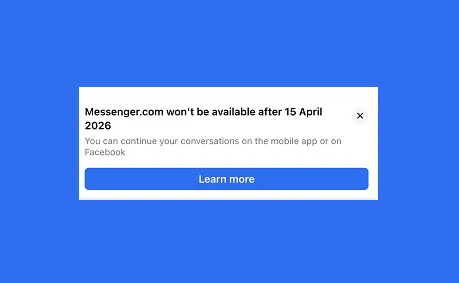
Messenger customers are being notified of the change, with a pop-up showing within the app, and on the web site, which explains that messenger.com will probably be going away on April 2026.
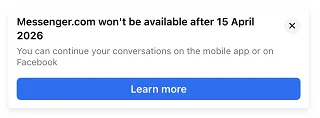
As per Meta: “Beginning April 2026, messenger.com will now not be obtainable for messaging. The Messenger desktop app can also be now not obtainable. You should utilize fb.com/messages to proceed messaging on internet.”
So that you’ll nonetheless be capable of ship and obtain messages on the internet, however that will probably be built-in into Fb, versus by way of a separate Messenger platform.
“After messenger.com goes away, you’ll be routinely redirected to make use of fb.com/messages for messaging on a pc. You’ll be able to proceed your conversations there or on the Messenger cell app. In the event you at present use Messenger and not using a Fb account, you possibly can proceed your conversations on the Messenger cell app.”
Meta additionally shut down the separate Messenger desktop app for Home windows and Mac in October final yr.
It’s a major shift in help for Messenger, although it’ll give Meta fewer platforms to take care of, lowering value and labor time.
Although as famous, it does additionally look like the most recent step in Meta’s altering method to messaging, and the way it seems to be to facilitate this as a separate perform.
For years, Meta had been engaged on a plan to combine Messenger, WhatsApp and Instagram Direct right into a single back-end infrastructure, which might then allow customers of every app to entry a common inbox, with all of their mixed messaging threads throughout every platform obtainable in a single place.
However then, in 2023, Meta introduced plans to reintegrate messaging again into Fb, making it a much bigger focus for engagement in the principle app, whereas it additionally added a separate DM inbox for Threads final yr, which appears to run counter to its messaging integration plan.
As a result of why add one other platform for those who’re nonetheless working to meld the others collectively, and why deliver messages again to the principle app, for those who’re working to construct them as a separate, mixed entity?
It could possibly be that Meta has deserted this push as a result of it now not feels that it wants it, with its long-running battle towards the FTC now, seemingly, in its rear-view.
The FTC has been in search of to pressure Meta to divest WhatsApp and Instagram, attributable to its view that Meta had used these acquisitions to quash competitors available in the market, and preserve dominance over the digital adverts area. A Federal Court docket decide dominated towards the FTC’s declare final yr, however with the case working for over seven years, it had been a major concern, which had seen Meta doubtlessly in search of to mix its messaging methods in an effort to shield itself towards the prospect of the ruling going towards it.
As a result of if all of its messaging instruments are melded collectively, then separating WhatsApp and Instagram could be unattainable, so even when Meta was compelled to divest the 2, it seemingly wouldn’t be capable of, and Meta would then be capable of construct a protection towards this order.
However with Meta profitable the case, which had appeared seemingly for a while, possibly it now not feels the necessity to implement this as a fail protected, which is why it’s now shifting away from separate messaging instruments, and seeking to reintegrate messaging into every of its separate apps (I’ve requested Meta for more information on whether or not the mixing plan remains to be going forward.)
Both method, the separate Messenger app goes away, and customers should message individuals on Fb as an alternative.
Which likely already do anyway.