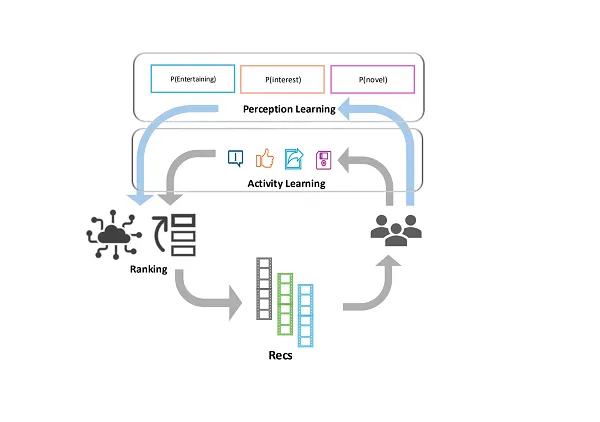
Meta has printed a new overview of the way it’s working to enhance your Reels suggestions, by utilizing consumer response surveys to higher gauge which parts are driving curiosity and engagement.

Little question you’ve seen these your self throughout the Reels feed, prompts which can be proven in-between movies that ask you the way you felt in regards to the Reel that you just simply watched. Meta says that it’s deployed this method on a big scale, and based mostly on the suggestions supplied, it’s gleaned extra data to assist refine and enhance its Reels suggestions.
As defined by Meta:
“By weighting responses to appropriate for sampling and nonresponse bias, we constructed a complete dataset that precisely displays actual consumer preferences – shifting past implicit engagement alerts to leverage direct, real-time consumer suggestions.”
So slightly than simply utilizing likes, shares and watch-time as indicators of curiosity, Meta’s trying to increase past this, and take into account extra parts that may additional enhance its suggestions.
And apparently it’s working.
In line with Meta, earlier than it deployed these surveys, its advice techniques have been solely attaining a 48.3% alignment with true consumer pursuits. However now, following the implementation of learnings based mostly on these surveys, that’s elevated to greater than 70%.
“By integrating survey-based measurement with machine studying, we’re making a extra partaking and customized expertise – delivering content material on Fb Reels that feels actually tailor-made to every consumer and encourages repeat visits. Whereas survey-driven modeling has already improved our suggestions, there stay necessary alternatives for enchancment, resembling higher serving customers with sparse engagement histories, decreasing bias in survey sampling and supply, additional personalizing suggestions for numerous consumer cohorts and enhancing the variety of suggestions.”
This method isn’t new, with Pinterest, for instance, detailing the way it’s used comparable surveys to collect suggestions to enhance its advice techniques.
However the price of enchancment is spectacular, and it’ll be fascinating to see whether or not this does result in a major enchancment in relevance to your Reels recommendations.
Although, actually, Meta’s nonetheless trailing TikTok on this respect.
TikTok’s almighty “For You” feed algorithm stays the benchmark for compulsive engagement, maintaining customers scrolling via the app for hours and hours on finish.
So what does TikTok’s algorithm have that Meta’s doesn’t?
Primarily, TikTok appears to have developed a greater system for entity recognition inside clips, which supplies the TikTok system extra knowledge to go on in matching up your preferences.
But, TikTok can be very secretive about how the algorithm works, and gained’t reveal a lot about this explicit ingredient, although we do know that TikTok’s system can determine very particular visible parts inside clips.
Again in 2019, The Intercept got here throughout a set of guiding ideas for TikTok moderators, which included a spread of very particular directions for coping with sure visible cues.
As per The Intercept:
“[TikTok] instructed moderators to suppress posts created by customers deemed too ugly, poor, or disabled for the platform [as well as] movies exhibiting rural poverty, slums, beer bellies, and crooked smiles. One doc goes as far as to instruct moderators to scan uploads for cracked partitions and ‘disreputable decorations’ in customers’ personal houses.”
These tips have been meant to maximise the aspirational nature of the platform, which might then drive extra development. TikTok admitted that such parameters did, at one time, exist, however it additionally clarified that these particular qualifiers have been by no means enacted in TikTok itself, with the parameters copied from an earlier doc meant just for Douyin, the Chinese language model.
Although their very existence means that TikTok can systematically detect these parts. I imply, you would assume that TikTok’s moderators have been trying to handle this manually, and reject movies together with these parts based mostly on human detection. However on the platform’s scale (each TikTok and Douyin have a whole bunch of hundreds of thousands of customers) would make this an not possible process, which might render these notes completely ineffective. Until the system might detect such via pc imaginative and prescient.
That’s the place TikTok actually wins out, in that it could actually perceive much more about what you’re taking a look at, then issue that into your suggestions. So for those who spend time taking a look at a video of a blonde-haired man with blue eyes, you possibly can guess that you just’re going to see extra content material from comparable wanting creators.
Develop that to any variety of bodily traits and background parts and you may see how TikTok is best in a position to align along with your particular preferences.
So whereas TikTok additionally makes use of the extra widespread matching, when it comes to likes, watch time, and so forth., it’s additionally working to maintain customers glued to their telephones by aligning with their extra primal leanings. And if the true depth of that course of have been ever made public, TikTok would doubtless come underneath intense scrutiny, as a result of it’s utilizing psychological bias and leanings to compel its customers, based mostly, probably, on problematic and even dangerous traits.
That’s the place Meta’s shedding out, as a result of it could actually’t implement the identical depth of understanding to enhance its techniques. Theoretically, it might use extra psychographic measures, based mostly on consumer historical past on Fb, and with older customers who’ve uploaded extra of their private knowledge to the app, that may be efficient. However principally, Meta is counting on extra widespread algorithm alerts, and now consumer surveys, to enhance the Reels feed.
Are your suggestions wanting higher of late? This might be why, whereas it also needs to imply that your content material is being proven to extra engaged audiences.