Are you trying to make LinkedIn a much bigger focus in 2026?
It will assist.
LinkedIn’s VP of Product Administration Gyanda Sachdeva has shared some new insights into key engagement tendencies within the app, in addition to tips on how customers can lean into them, with a view to enhance their content material efficiency.
And LinkedIn is getting extra consideration. Sachdeva says that over the previous 12 months, content material sharing within the app is up 15%, whereas feedback within the feed have elevated by 24%.
Double-digit rises in engagement level to expanded alternative, and the following tips may steer you on the suitable path to boosting your LinkedIn efficiency.
First off, Sachdeva says that customers ought to share their experience and expertise within the app.
As per Sachdeva:
“Folks need to hear from different people, they usually need to hear actual, lived experiences and insights. We constantly see that the content material driving the strongest engagement falls into a couple of key themes – and our members inform us they need extra of those.”
These themes are:
- Business information and your perspective on it, product bulletins, or tendencies shaping your subject
- Informative content material, particularly round work, enterprise, or the economic system
- Profession tales and recommendation from your individual lived expertise, that includes insightful classes and tales that solely you possibly can inform
So your individual skilled insights, guided by your individual experiences, which no person else has. That’s precious, and should you can seize your learnings into concise summaries, these ought to do nicely on LinkedIn.
However don’t use AI to generate these for you.
LinkedIn has added AI instruments into each factor of its app, together with put up creation, although even Sachdeva notes that relying an excessive amount of on AI shouldn’t be the way in which to go:
“One factor I do need to reiterate is that whereas I encourage you to make use of AI as a instrument to brainstorm or sharpen your considering, professionals need to hear from actual professionals about actual experiences. AI is finest used to reinforce your expression. Consider AI as a instrument, not a crutch: members, not AI, energy the most effective engagement on LinkedIn.”
So why, then, would LinkedIn add this as a put up technology choice?
I don’t know, however I’d encourage customers, particularly on LinkedIn, to not use AI as a alternative for their very own ideas and insights.
On a associated entrance, LinkedIn additionally continues to extend its actions to handle pretend engagement in-stream.
As we reported earlier this 12 months, many LinkedIn customers have reported seeing examples of automated engagement, and engagement pod exercise within the app.
LinkedIn knowledgeable us in July that it’s trying to make this a much bigger focus, and in a separate put up, LinkedIn’s VP of Product Oscar Rodriguez has offered an replace on its efforts to handle this:
“Over the previous couple of months, we’ve continued to take important steps to handle this. We’ve eliminated LinkedIn teams exhibiting indicators of engagement pod behaviors. We’ve additionally reached out to 1000’s of members whose actions confirmed indicators of participation in engagement pods or use of automated commenting instruments, reminding them of our insurance policies and warning of attainable account restrictions and removals from LinkedIn packages, together with High Voices.”
So LinkedIn is trying to deal with platform misuse in a focused means, and you may count on to see extra motion on this entrance in 2026.
When it comes to posting frequency, Sachdeva says that customers ought to goal to publish between 2-5 LinkedIn posts per week for optimum affect, with members who put up twice per week seeing as much as 5x extra profile views on common.
“For finest outcomes, deal with high quality and contemplate spacing out posts to present every respiratory room when on very comparable subjects. Understand that posting greater than as soon as a day received’t damage your complete attain, however folks need to see content material from a variety of voices. When you share a number of posts shut collectively, members will seemingly see the one that’s most related to them.”
Sachdeva has additionally addressed latest questions on algorithm adjustments, and the relative impacts on put up attain:
“Distribution and attain naturally fluctuate primarily based on what you’re posting, issues like the subject, timing, format, and even what your viewers is participating with that day. And since extra persons are posting and becoming a member of conversations on LinkedIn there’s merely extra exercise within the feed general. That naturally means a bit extra competitors but additionally extra alternatives for creators and viewers alike.”
So, extra folks posting may imply much less attain for every person, whereas Sachdeva has additionally responded to latest questions on attainable gender bias in LinkedIn’s algorithm:
“There are various indicators that may affect the distribution of your put up, corresponding to usefulness and uniqueness of the content material, timeliness of the subject, relevance to the viewer, frequency of posting, use of media, should you’ve obtained context within the video put up caption, or whether or not the language feels promotional or generic. These and lots of different elements decide what will get distributed and to whom. Importantly although, we don’t consider gender, age or different demographics of the poster into content material rating.”
Many customers have performed their very own experiments on this, and haven’t been happy with LinkedIn’s reply, which is just that such bias doesn’t occur. However primarily based on official recommendation from LinkedIn, this shouldn’t be a consider content material rating.
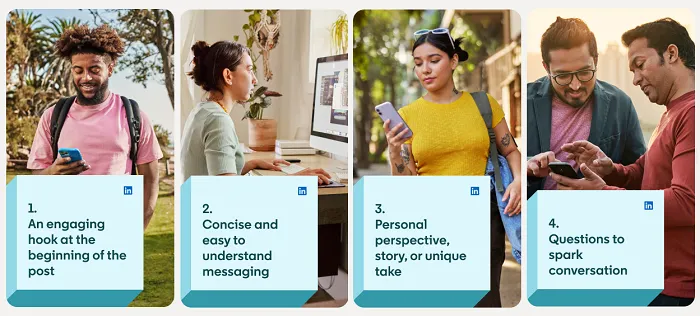
Sachdeva additional notes that customers ought to deal with creating related, well timed posts that spark conversations in your viewers.
“A robust first sentence, a transparent perspective and a easy narrative that brings folks into the story can go a great distance in serving to your content material land.”
That very same recommendation is included on LinkedIn’s creation suggestions web page:
Sachdeva additionally reiterates that hashtags are usually not vital:
“Hashtags don’t affect distribution, so no want to incorporate them. When you nonetheless need to embody them for different causes, corresponding to your individual monitoring or to assist members seek for them since they’re clickable, you possibly can proceed to take action.”
Whereas video posts are additionally driving huge response within the app:
“Video is a key a part of LinkedIn’s content material ecosystem, and it’s considered one of a number of highly effective methods to share your voice. By video, we’re unlocking entry to shared experiences and knowledge from different professionals to assist members navigate their skilled journey extra meaningfully.”
LinkedIn additionally beforehand reported that movies are 20x extra prone to be shared within the app, whereas video content material additionally generates 1.4x extra engagement than different put up sorts.
As such, it’s undoubtedly value contemplating, and Sachdeva says {that a} sturdy hook, highlighted in textual content type, is vital to driving video engagement.
Some precious pointers from one of many individuals who’s accountable for overseeing how LinkedIn’s programs run, and as such, has in-depth data of its content material focus, in addition to utilization tendencies.
Value noting in your 2026 strategy.


