Conversion ends in Adverts Supervisor attributed to a click on have traditionally included extra layers than most advertisers understood. It led to confusion about what outcomes meant. Fortunately, Meta is making an essential change.
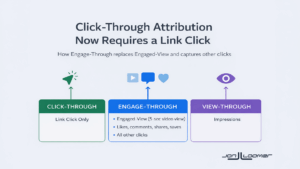
Click on attribution will lastly require a click on on a hyperlink — no different clicks will likely be included. Along with asserting this transformation at present, “engaged-view” will likely be up to date in identify and substance to “engage-through.”
Right here’s what you must know…
The Change to Click on-Via Attribution
Click on-through attribution is how Meta offers credit score for a conversion when somebody converts after clicking an advert. Whereas that will appear straight-forward, it’s not — and positively wasn’t.
In reality, I misunderstood the underlying which means for a decade. It wasn’t till I ran a check greater than a 12 months in the past that I used to be capable of verify the reality behind click-through attribution: Meta counted a conversion when it occurred following any click on in your advert.
It didn’t should be a click on on a hyperlink. It may have been a like, share, remark, or different click on. If somebody clicked your advert after which transformed inside seven days, Meta counted it underneath click-through attribution.
I discovered this to be unnecessarily complicated, if not deceptive. It was simple to imagine {that a} hyperlink click on would have been required. However a part of the rationale that this was simple to overlook was that Meta’s previous definition was imprecise.
Ultimately, Meta up to date the definition of click on attribution to precisely replicate any click on. However now, Meta is altering the definition of click on attribution once more.
“Going ahead, we’re altering the definition of click-through attribution for web site and in-store conversions to completely embody hyperlink clicks.”
That is excellent news. It ought to assist align conversion outcomes with expectations primarily based on visitors pushed from adverts.
The New Have interaction-Via Attribution
Meta isn’t finished making modifications to attribution.
Conversions that resulted from reactions, feedback, shares, saves, or different non-link click on actions will likely be included in engaged-view attribution. To account for this transformation, Meta is renaming it “engage-through attribution.”
In the event you’re not acquainted with the previously named “engaged-view” attribution, it’s a part of the default attribution setting (7-day click on, 1-day engaged-view, and 1-day view).
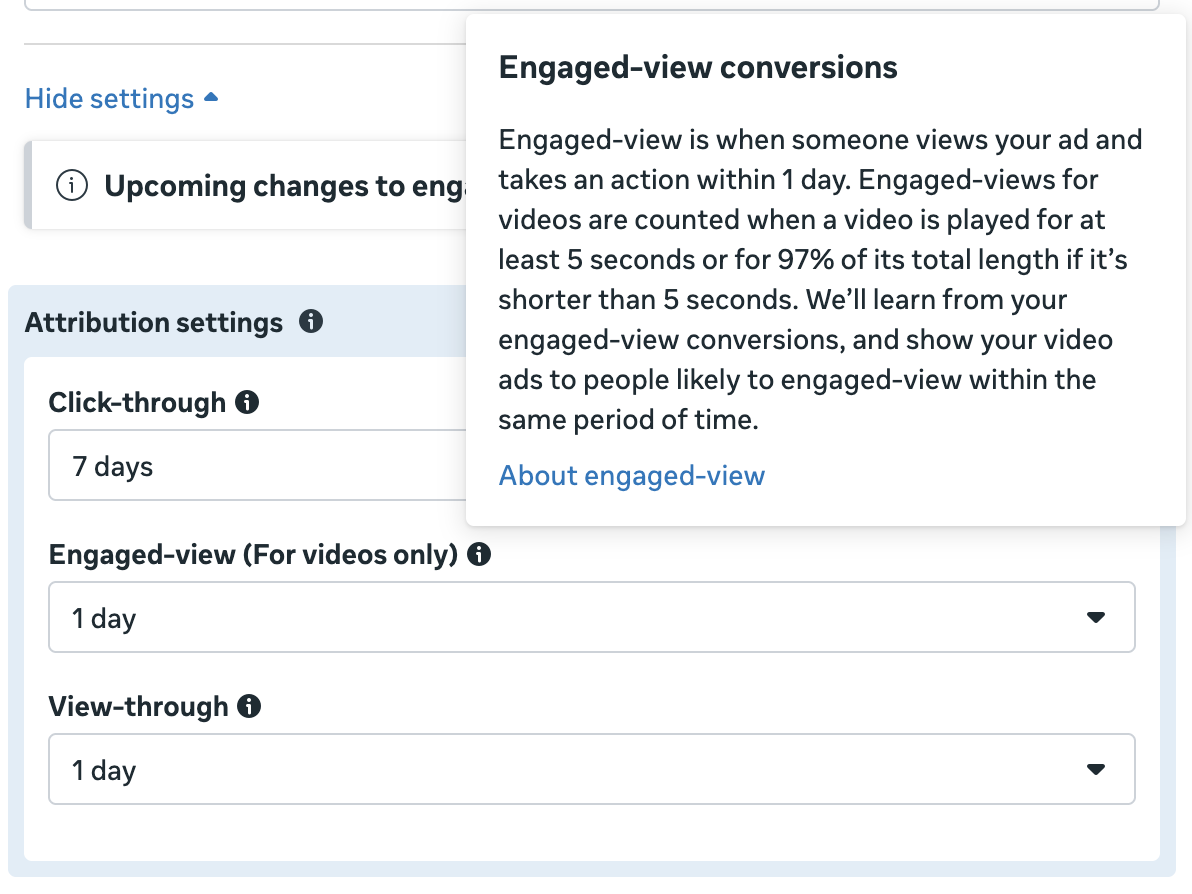
An engaged-view is counted when somebody views your video for at the very least 5 seconds (previously 10) and converts inside a day. If the video is lower than 5 seconds lengthy, at the very least 97% of it must be watched.
So the brand new engage-through attribution will embody the previous engaged-view conversions, but additionally all conversions that resulted from clicks that weren’t hyperlink clicks. And in contrast to engaged-view, which utilized solely to movies, the brand new engage-through will apply to all codecs.
What Are Hyperlink Clicks?
Some additional clarification is required right here about hyperlink clicks as a result of it’s not fairly as apparent as chances are you’ll suppose.
Meta’s definition of hyperlink clicks consists of clicks on hyperlinks to web sites. However it additionally consists of a number of different clicks.
- Web sites
- App shops or app deep hyperlinks
- Click on to name
- Click on to message
- Maps/instructions
- Retailers
- Lead kinds
- Market
- Hyperlink clicks to Instagram profiles for adverts selling Instagram profile views
- Playable experiences
- Movies that launch the watch & browse expertise
- Movies hosted by one other web site (together with movies embedded in Feed adverts however hosted on a video platform corresponding to YouTube or Vimeo)
Whereas this will likely look like an extended checklist of potential loopholes, these “different” hyperlink clicks needs to be exceedingly uncommon when utilizing the Web site conversion location and the efficiency targets to maximise the quantity or worth of conversions. And that’s when limiting hyperlink clicks to these to an exterior web site will likely be most essential.
Nonetheless, it will have been higher if Meta had gone all the best way on this. Why not change the definition of click-through attribution to require a click on to an outbound hyperlink?
Abstract of Modifications
Let’s simplify what occurred…
1. Click on-through attribution now requires a click on on a hyperlink previous to a conversion.
2. Have interaction-through attribution replaces engaged-view.
3. Have interaction-through consists of engaged-view and all different clicks that aren’t clicks on hyperlinks.
Attribution is messy, so this stays considerably sophisticated. However it’s a constructive change.
Impression of Modifications
The first affect of this transformation is that your click-through conversion outcomes ought to match extra carefully with Fb-referred conversions in third-party reporting — significantly when isolating conversions from 1-day click on.
Past that, what do you have to count on to see?
One of many issues with the previous definition of click-through attribution was that it was unattainable to isolate which conversions resulted from clicks on hyperlinks and which had been from different clicks. Third-party reporting may assist get a normal concept, however there was no verifiable proof.
My hunch is that only a few conversions will transfer out of click-through and into engage-through attribution as a result of they got here from “different” clicks. I doubt that liking, commenting on, sharing, or saving your advert earlier than changing — and with out really clicking on a hyperlink — can be a typical prevalence.
You continue to may discover a slight drop in click-through attribution outcomes. However any decline needs to be changed by a rise in engage-through outcomes. And assuming you retain the brand new engage-through attribution setting (which is included by default) checked within the advert set, you gained’t discover any distinction in your complete outcomes.
Your outcomes lump collectively all conversions, whether or not from click-through, engage-through, or view-through. Any distinction might be noticed when you break these conversions out utilizing the Evaluate Attribution Settings function or Breakdown by Attribution Setting.
That mentioned, those that manually turned engaged-view — and now engage-through — attribution off may discover a drop in complete reported conversions.
Your Flip
What do you consider this transformation?
Let me know within the feedback under!
The submit Click on-Via Attribution Now Requires a Hyperlink Click on appeared first on Jon Loomer Digital.